Hear Clearly Again With Care That Gets It Right
Dr. Allan Franklin, Au.D. — three decades of clinical experience — brings diagnostic evaluations, verified fittings, and real ear measurement directly to your home across Raleigh, Cary, and Apex.

Most people who walk away disappointed from hearing aids were not failed by the technology. They were failed by a process that skipped steps. A quick tone screening stood in for a full diagnostic workup. A device was selected from a manufacturer's catalog rather than matched to a specific loss. Settings were programmed using generic software assumptions rather than a measurement taken inside the ear. The result is a hearing aid that sits in a drawer — and a person who concludes, incorrectly, that hearing aids just don't work for them.
Good hearing care follows a clinical sequence that does not allow shortcuts. First, you measure the loss accurately — not just whether hearing loss is present, but exactly what kind, at which frequencies, and by how much. That diagnostic evaluation also screens for findings that call for a physician rather than an amplifier. Second, you select and program a device on clinical grounds, fitting it to the specific loss, ear anatomy, manual dexterity, and listening demands of that individual. Third, you verify the output — using real probe microphone measurements at the eardrum — to confirm the device is delivering what the prescription calls for. Each step depends on the one before it. None of them is optional.
Dr. Allan Franklin, Au.D., brings all three of these services directly to your home across the North Carolina Triangle — Raleigh, Cary, and Apex — in a fully equipped mobile clinic. He performs the same diagnostic workup, the same evidence-based fitting process, and the same real ear verification that a fixed audiology office uses. The only thing that changes is that you do not have to leave your home to receive it. This page explains what each service involves, why it matters, and what you should expect from each appointment — so that if you have had a frustrating experience with hearing aids before, you can see exactly where the process may have broken down.
Hearing aid evaluations: a diagnostic workup, not a screening
A hearing aid evaluation is a complete diagnostic appointment — case history, otoscopy to examine the ear canal and eardrum, air and bone conduction thresholds across the speech frequencies, speech reception and word recognition testing, and tympanometry to assess middle-ear function. It also includes speech-in-noise testing, because the quiet test booth is rarely where people struggle, and a detailed listening-needs interview to understand which specific situations — conversations at dinner, voices on television, phone calls — have become difficult. That history is what turns a set of thresholds on a chart into a treatment plan with defined goals. Some findings at evaluation point away from hearing aids entirely: sudden change, asymmetry between ears, drainage, or pain calls for a physician referral before any device conversation begins. You leave the appointment with a plain-language review of your own audiogram and a copy of it.
Hearing aid fittings: the device is the tool, the fitting is the treatment
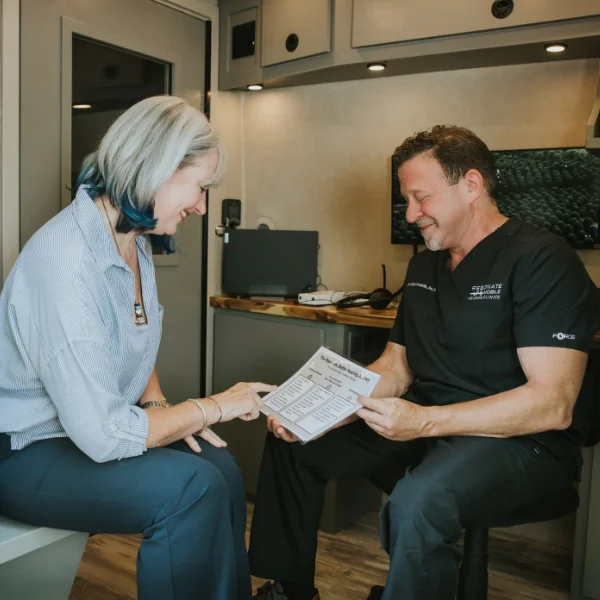
Two people with identical audiograms can need very different hearing aids, and the same device can succeed for one and fail for the other depending entirely on how it was fit. Selection is based on clinical grounds: degree and configuration of loss, ear anatomy, manual dexterity, vision, the specific listening environments that matter to you, and the technology you already use. Style and price tier follow from that analysis — not the other way around. Resonate is manufacturer-independent, so every major manufacturer is available and there is no house brand influencing the recommendation. At the fitting appointment, devices are programmed to a validated prescriptive target derived from your audiogram, verified with real ear measures, and then fine-tuned to your response in the room. Insertion, removal, cleaning, charging, and phone pairing are taught at the appointment, along with an honest account of what the first two weeks of adjustment will feel like.
Real ear measures: the only way to confirm what the hearing aid is actually doing
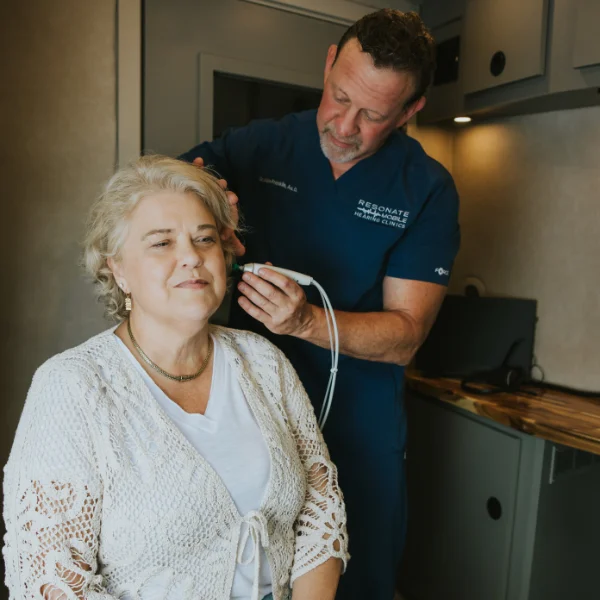
Real ear measurement — also called probe microphone measurement or REM — places a thin probe microphone in the ear canal alongside the hearing aid while it plays live speech. It reports the sound level reaching your eardrum, frequency by frequency, and compares it to the prescriptive target for your specific loss. Without this step, a fitting is an educated guess. Ear canals differ substantially in length, volume, and shape, and those differences change the sound at the eardrum by many decibels — most of it in the high frequencies where consonant clarity lives. Research has consistently shown that generic first-fit software settings miss prescribed targets, most often by under-amplifying exactly where speech understanding is won or lost. Real ear measures replace that assumption with a measurement, which is why verified fittings require less trial-and-error and are returned less often. Every Resonate fitting is verified this way, the measurements are part of your permanent record, and re-verification follows any significant programming change.
Why mobile delivery does not mean a compromise in clinical standards
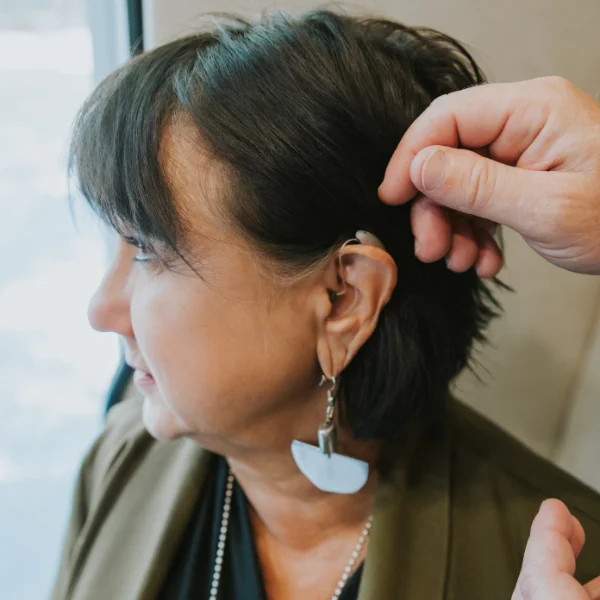
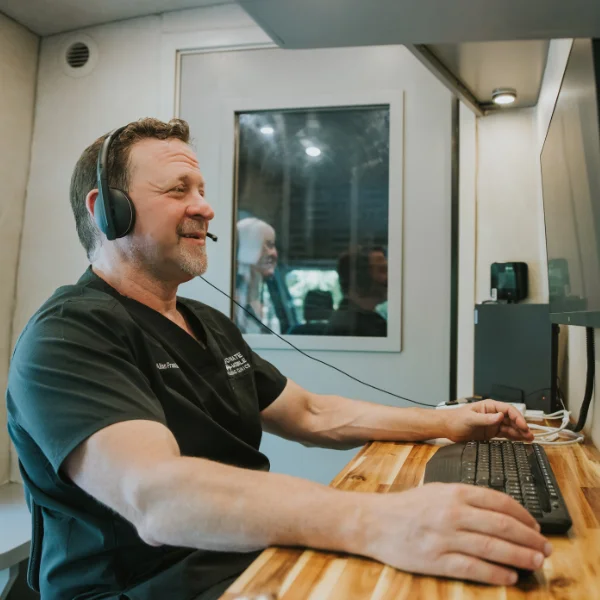
The mobile clinic carries the same diagnostic and verification equipment used in a fixed audiology office — calibrated audiometric testing equipment, a controlled acoustic test environment, and real ear measurement instrumentation — because the clinical standards do not change based on where the appointment takes place. What changes is the convenience and, for many older adults, the accuracy of the information gathered. A patient tested and fit in their own home is sitting in the acoustic environment they actually live in, not an unfamiliar office they drove to while already fatigued. Follow-up appointments happen at your home, which means patients actually keep them — and follow-through is where outcomes are built. Dr. Franklin serves Raleigh, Cary, Apex, and the surrounding North Carolina Triangle, and every appointment is conducted at the patient's home.
The three services — evaluation, fitting, and real ear verification — are not add-ons to each other. Each one is necessary. Skipping any one of them is the most common reason hearing aids end up in a drawer.
Common Questions
What is the difference between a hearing screening and a hearing aid evaluation?
A screening tells you whether hearing loss is likely present — it is a pass-or-fail tone test, not a diagnosis. A hearing aid evaluation is a complete diagnostic workup that measures the exact type, degree, and configuration of the loss across frequencies, tests speech understanding, checks middle-ear function, and identifies any findings that require a physician rather than an amplifier. You cannot make a sound clinical recommendation for hearing aids from a screening alone.
Do I really need real ear measures, or is the hearing aid's built-in software enough?
The built-in software predicts an average ear canal — yours is almost certainly different. Those anatomical differences change the sound reaching your eardrum by a significant number of decibels, especially in the high frequencies where consonant clarity is determined. Real ear measures replace that prediction with an actual measurement, which is why research consistently shows verified fittings outperform unverified ones on speech understanding outcomes.
What happens if the evaluation finds something other than typical hearing loss?
Certain findings — sudden hearing change, a significant difference between ears, drainage, pain, or abnormal middle-ear pressure — can indicate a medical condition that should be evaluated by a physician before any hearing aid discussion. Dr. Franklin refers appropriately when those findings are present, and no device recommendation is made until the medical question is resolved. Identifying these cases is one of the core purposes of a full diagnostic evaluation.
How many appointments does the full process take?
For most patients the diagnostic evaluation is one appointment and the fitting is a separate appointment, because the fitting is programmed specifically to your audiogram results and requires preparation. Real ear measures are performed at the fitting appointment and again after any significant programming change. Follow-up appointments are scheduled over the months after the fitting, because the brain's adaptation to amplification continues for some time and settings benefit from refinement against real-world experience.
Is a mobile clinic really equipped to do all of this at my home?
Yes. The Resonate mobile clinic carries calibrated audiometric testing equipment, a controlled acoustic environment, and real ear measurement instrumentation — the same categories of equipment used in a fixed audiology practice. The appointments are not a field approximation of clinical care; they are clinical care delivered at your home.
Ready to start? Dr. Franklin brings the evaluation to your home.
The right starting point is a full diagnostic evaluation that gives you a clear picture of your hearing and a copy of your own audiogram. Dr. Allan Franklin, Au.D., serves Raleigh, Cary, Apex, and the surrounding North Carolina Triangle — every appointment at your home.